陳美合 博士學術網
畫作Painting
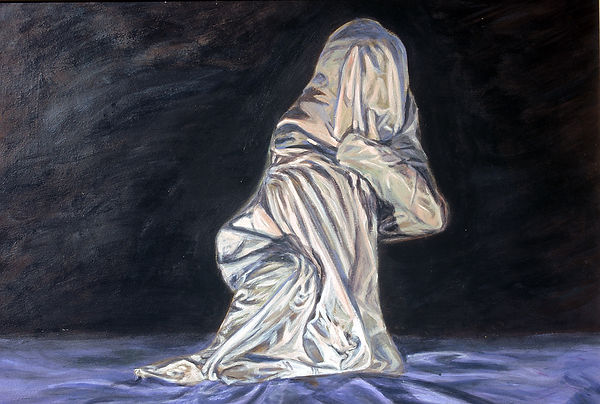
祈禱
Prière
Pray
作品《祈禱》以如雕塑般的布紋線條,刻畫出一個覆蓋於衣袍之下、虔誠跪伏的身影。畫面中流暢而緊繃的布料褶皺,交織出層次豐富的光影變幻,將內心的沉思、掙扎與渴望,凝聚成一具無聲卻飽含生命張力的祈願之姿。
"Prayer" captures a kneeling figure entirely shrouded beneath robes, rendered with sculptural drapery and lines. The smooth yet taut folds of the fabric weave together rich layers of light and shadow, crystallizing inner contemplation, struggle, and longing into a silent yet powerful posture of supplication.
L’œuvre « Prière » dépeint une silhouette agenouillée et recueillie, entièrement enveloppée sous des drapés aux lignes sculpturales. Les plis de l'étoffe, à la fois fluides et tendus, s'entrelacent dans un jeu d'ombre et de lumière d'une grande richesse, cristallisant la méditation intérieure, la lutte et le désir en une posture de supplication silencieuse mais empreinte d'une puissante vitalité.

-沉思中的佛陀(1995)
Le Bouddha en contemplation
-
這幅題為《沉思中的佛陀》的作品,展現了一種極具張力與哲思的視覺語彙。整幅畫作透過流動的布紋、深邃的背景與獨特的色調,將傳統佛陀的靜謐意象重新詮釋為一種深層的內在探尋:
1. 構圖與造形:結跏趺坐與解構的軀體
畫作中央呈現一個經典的打坐/結跏趺坐姿態。然而,創作者並未直接刻畫具象的佛像面容與肉身,而是將整個軀體包覆於厚重且繁複的摺皺(Drapery)之中:
-
頭部與上半身: 微向前傾,呈現專注、內省的沉思姿態。
-
褶皺的層次: 繁複的布紋沿著身軀的線條交織扭結,既像是一層防禦性的繭,又像是內在精神能量在布面下的流動與凝結,賦尤作品極強的雕塑感。
2. 光影與色彩:金屬光澤與深沉背景
-
主體色調: 身軀與布料運用了金黃、琥珀、乳白與帶有些許紫粉的複合光影,展現出宛如絹絲、金屬乃至化石般的特殊質感。明亮的暖色調在主體上形成強烈的光影對比,突顯出摺皺的立體與厚重。
-
背景氛圍: 背景以暗紫、深棕與黑色為主,筆觸呈現如岩洞、帷幕或原始地質結構般的動態紋理,將中央光輝奪目的沉思主體烘托得更加集中且深邃,營造出一種獨立於世俗時間之外的冥想空間。
3. 意象與哲思:從具象到精神的凝結
作品將「佛陀」這一符號進行了高度的抽象化與意象化處理:
-
去除了具體面容後,沉思不再只是「特定神祇」的狀態,而轉化為一種普遍的精神經驗——一種關於內省、寂靜、凝練與精神轉化的視覺化呈現。
-
繁複的布褶宛如心靈演變的軌跡,在極度的靜止中孕育著極大的精神力量。
Cette œuvre intitulée « Le Bouddha en contemplation » déploie un vocabulaire visuel empreint d'une intense tension et de philosophie. À travers des draperies fluides, un arrière-plan profond et des nuances singulières, la peinture réinterprète l'imagerie paisible du Bouddha traditionnel en une quête intérieure profonde :
1. Composition et formes : Posture en lotus et corps déconstruit
Au centre de la composition se dresse la posture classique de la méditation en lotus (padmasana). Cependant, l'artiste choisit de ne pas figurer directement les traits du visage ni le corps anatomique du Bouddha, mais enveloppe l'ensemble de la silhouette dans un drapé lourd et complexe :
-
Tête et haut du corps : Légèrement inclinés vers l'avant, traduisant une attitude de méditation concentrée et introspective.
-
Superposition des plis : Les plissés complexes s'entrelacent et se tordent le long des lignes du corps, évoquant à la fois un cocon protecteur et le flux ou la condensation d'une énergie spirituelle sous l'étoffe, conférant à l'ensemble une remarquable dimension sculpturale.
2. Lumière et couleur : Éclats métalliques et arrière-plan profond
-
Tonalités du sujet principal : Le corps et les draperies déploient des jeux de lumière complexes déclinés en tons dorés, ambrés, blanc cassé et de subtiles nuances violacées. L'ensemble révèle une texture singulière rappelant la soie, le métal ou la matière fossile. Les teintes chaudes et lumineuses créent un fort contraste d'ombre et de lumière, soulignant le volume et la densité des plis.
-
Atmosphère du fond : Traité dans des dominantes de violet sombre, de brun et de noir, l'arrière-plan présente des coups de pinceau dynamiques évoquant la paroi d'une grotte, une draperie mouvante ou une structure géologique primordiale. Il détache le sujet central étincelant avec force et profondeur, créant un espace de méditation suspendu hors du temps.
3. Symbolique et philosophie : De la figuration à la condensation spirituelle
L'œuvre opère une stylisation et une abstraction poussées de la figure du Bouddha :
-
En dépouillant le sujet de son visage figuratif, la contemplation cesse d'être l'état d'une divinité particulière pour devenir une expérience spirituelle universelle — la matérialisation visuelle de l'introspection, du silence, de la concentration et de la transformation intérieure.
-
La complexité des plis devient le sillage des mouvements de l'esprit, générant au cœur d'une immobilité absolue une immense force spirituelle.
This artwork, titled "Buddha in Contemplative Thought" (or "Buddha in Meditation"), presents an intensely powerful and philosophical visual vocabulary. Through fluid drapery, a deep background, and a distinctive color palette, the painting reinterprets the serene imagery of the traditional Buddha into a profound journey of inner exploration:
1. Composition & Form: The Lotus Posture and Deconstructed Silhouette
At the center of the canvas lies the classic crossed-leg sitting pose (padmasana). However, the artist chooses not to depict the Buddha's concrete facial features or physical body directly, instead enveloping the entire form in heavy, intricate folds of drapery:
-
Head and Upper Body: Leaning slightly forward, conveying an attitude of focused, inward-looking meditation.
-
Layers of Drapery: Complex folds intertwine and twist along the contours of the body. They act both as a protective cocoon and as the flow or condensation of inner spiritual energy beneath the fabric, imparting a remarkable sculptural presence to the piece.
2. Light & Color: Metallic Sheen and Atmospheric Depth
-
Primary Subject Palette: The figure and fabric incorporate a sophisticated interplay of light and shade—golden yellows, ambers, off-whites, and subtle purplish-pink undertones. This reveals a unique texture reminiscent of silk, metallic sheen, or even fossilized mineral. The bright, warm tones create a stark contrast against the shadows, highlighting the volume and density of the folds.
-
Background Atmosphere: Rendered in dominant tones of dark violet, deep brown, and black, the background features dynamic brushstrokes that evoke a cave wall, shifting drapery, or a primordial geological formation. This isolates the luminous central subject with dramatic depth, creating a meditative space suspended outside of ordinary time.
3. Symbolism & Philosophy: From Figuration to Spiritual Condensation
The artwork performs a high degree of abstraction and stylization on the motif of the Buddha:
-
By stripping away a specific facial likeness, contemplation ceases to belong to a particular divine entity and transforms into a universal spiritual experience—a visual embodiment of introspection, silence, focus, and inner transformation.
-
The intricate complexity of the folds serves as the lingering trace of the mind's inner movements, generating immense spiritual energy from the heart of absolute stillness.

-441 靈動(1995)
The Spiritual Vitality of 441-
此作品聚焦於佛陀菩提樹下成道的關鍵瞬間。畫面刻畫佛陀沉思頓悟的剎那,空中十萬紫膠蟲如雲煙般繚繞、翩翩起舞,以其獨特的視覺語言,傳達了覺悟時刻的天地動容與法喜充滿。
This artwork focuses on the pivotal moment of the Buddha’s enlightenment beneath the Bodhi tree. Depicting the instant of deep contemplation and awakening, a cloud of a hundred thousand lac insects dances spiraling through the air. Through its unique visual language, the piece conveys the cosmic wonder and radiant spiritual joy of that transcendent moment.
Cette œuvre met en lumière le moment crucial de l’éveil du Bouddha sous l’arbre de la Bodhi. Peignant l’instant précis d'une profonde contemplation et d'une illumination soudaine, une nuée de cent mille kermès à laque s'élève en une danse spiralée dans les airs. Grâce à son langage visuel unique, la pièce retranscrit la merveille cosmique et la joie spirituelle rayonnante de ce moment transcendant.

-致命的吸引力
Fatal Attraction-
(2022台中市青溪文藝學會聯展)
(2022 Taichung Ching-Hsi Arts and Literature Association Joint Exhibition)》作品《致命的吸引力》聚焦於海洋污染議題。畫中隨波漂浮的塑料,形態擬似水母,這份虛幻的美感成了海龜無法辨識的致命陷阱。
“Fatal Attraction” focuses on the issue of marine pollution. The plastics drifting with the waves closely resemble jellyfish; this illusion of beauty becomes a deadly trap that sea turtles fail to recognize.
L’œuvre « Fatal Attraction » met en lumière l'enjeu de la pollution marine. Les plastiques flottant au gré des vagues ressemblent à s'y méprendre à des méduses ; cette beauté illusoire se transforme en un piège mortel, indécelable pour les tortues marines.

-藤枝筠霧-
(2024台中市青溪文藝學會聯展)
"Misty Bamboo in Tengzhi" (2024 Taichung Ching-Hsi Arts and Literature Association Joint Exhibition)
作品《藤枝筠霧》描繪了山林迷離之美。當濃霧徐徐籠罩,原本秀麗的山景逐漸隱沒於雲霧之中,輪廓難辨,營造出一種虛實相生、若隱若現的空靈意境。
Mist over Tengzhi portrays the hazy, ethereal beauty of the mountain forest. As dense mist slowly shrouds the landscape, the majestic peaks fade into the clouds, their contours becoming indistinct—creating an poetic atmosphere where reality and illusion intertw inexhaustibly
.
Le brouillard sur Tengzhi dépeint la beauté vaporeuse et éthérée de la forêt de montagne. Alors qu'une brume dense enveloppe lentement le paysage, les sommets majestueux se fondent dans les nuages et leurs contours s'estompent—créant une atmosphère poétique où la réalité et l'illusion s'entremêlent à l'infini.

-歲月如梭-
(2023國際彩墨行旅記憶藝術大展)
"Time Flies Like a Shuttle" (2023 International Ink Painting: Travel Memories Art Exhibition)
歲月如梭 承載無數行旅記憶 交織璀璨人生
癸卯年創作
Les années filent comme une navette, portant d'innombrables souvenirs de pérégrinations, s'entremêlant pour former une vie splendide. Créé en l'année Guimao.
As time flies like a weaver's shuttle, carrying countless memories of journeys intertwining to form a brilliant life. Created in the Year of Guimao.


-彰化媽潦溪印象-
(2024國際彩墨民俗風情藝術大展)
"Impressions of Changhua Mazu’s River Crossing" (2024 International Ink Painting: Folk Customs Art Exhibition)
這是一件非常有張力且富有深意的抽象藝術作品,成功地捕捉了「彰化媽潦溪」這一宗教盛事的動態與精神內涵。提供的兩張圖片,一張是作品整體的直幅構圖,另一張是下半部的細節放大,這有助於更深入地欣賞這件作品。
以下是對這件作品的藝術賞析:
一、 核心意象:動態與力量的對比
這幅畫作最成功的關鍵在於「火」與「水」的抽象對比。
-
紅色與橘色的「火」: 畫面中上方的紅色幾何結構(類似一個抽象的轎子或神龕)以及周圍的橘色、黃色光暈,強烈地代表了「彰化媽」的神聖力量、進香隊伍的熱情、火把、以及鞭炮的喧囂。這種紅色不是靜止的,它與周圍的黑色雲霧(類似硝煙)交織在一起,表現出一種動態的、熱烈向前的氣勢。
-
藍色與白色的「水」: 畫面下方和右側大面積的藍色、白色流動紋理,顯然是「溪水」的抽象表現。這種水紋既有藍色的深邃,又有白色的浪花和湍流感,巧妙地使用了類似中國水墨「潑墨」或「暈染」的技法,讓水看起來既真實又具有一種精神上的流動性。
二、 抽象構圖:過程與艱難
整幅畫作(直幅構圖)呈現出一種向上的動勢。下方的「溪水」雖然廣闊、洶湧,但上方的「神火」依然堅定地前進。這完美地對應了「潦溪」的過程——信眾和神轎必須跨越湍急的溪水,這是一個艱難的過程,但也象徵著信仰的堅定不移。
紅色幾何結構並不是一個清晰完整的圖像,它與周圍的黑色硝煙和煙塵融為一體,這不僅表現了現場混亂、熱烈的氣氛,也暗示了神力的抽象與不可捉摸。
三、 細節詮釋:信仰的軌跡
-
右側的小亮點: 在畫面的右側,有許多小小的、偏暖色的亮點(如細節圖所示),它們像是遠處的火把,或是被風吹散的香火灰燼,這豐富了畫面的層次感,也暗示了參與隊伍的龐大和信仰的綿延。
-
左下角的符記: 在左下角的藍色水紋中,隱約可見幾個類似「金紙」或「符咒」的長方形幾何圖形(有些上面還有金色的亮點),這是一個非常重要的象徵性細節,它代表了信眾對神明的祈求、信仰的物化,以及神明在溪水中對信眾的庇佑。
-
左上角的黃色光點: 在黑色硝煙最濃重的地方(左上角),有一些明亮的黃色光點,它們像是破曉時分的光芒,或是神明顯靈的象徵,為整幅畫作增添了一絲希望和神秘感。
四、 技法與材質:中西合璧的探索
這件作品顯然使用了水性媒材(可能是水彩、水粉或壓克力,並結合了水墨技法)在帶有紋理的紙張或畫布上創作。
-
潑墨與暈染: 藍色溪水的處理非常純熟,充分利用了水分的流動和顏料的暈染,創造出豐富的層次和湍流感,這具有中國傳統水墨的韻味。
-
乾筆與刮擦: 在黑色和紅色的交界處,可以看到一些類似乾筆(Dry-brush)刮擦或噴灑的技法,這表現了「煙塵」和「火花」的顆粒感,增加了畫面的觸覺感受。
總結
這幅「彰化媽潦溪印象」是一件傑出的抽象藝術作品。它不追求具象的還原(比如畫出清晰的人、神轎和溪水),而是通過強烈的顏色對比(水火交融)、動態的構圖、以及富含象徵意義的細節,成功地捕捉了這一宗教儀式背後的精神力量、集體情感以及「人與自然、神與人」之間的動態平衡。這是一幅充滿動態、情感和哲學思考的佳作。
Cette œuvre d'art abstrait, d'une remarquable intensité et d'une grande profondeur, réussit à capturer la dynamique ainsi que la dimension spirituelle d'un événement religieux majeur : le pèlerinage du « franchissement de la rivière par la Déesse Mazu de Changhua » (Changhua Ma Liaoxi). Les deux images fournies — l'une montrant la composition verticale globale et l'autre un gros plan de la partie inférieure — permettent d'apprécier ce travail en détail.
I. Motifs centraux : Le contraste du mouvement et de la force
La réussite clé de cette peinture réside dans le contraste abstrait entre « le feu » et « l'eau » :
-
Le « feu » rouge et orange : La structure géométrique rouge dans la partie supérieure centrale (évoquant un palanquin abstrait ou un sanctuaire) ainsi que l'auréole orange et jaune qui l'entoure incarnent avec force la puissance sacrée de Mazu, la ferveur des pèlerins, les torches et le fracas des pétards. Ce rouge n'est pas statique ; il s'entrelace avec les nuées sombres environnantes (évoquant de la fumée de poudre), exprimant un mouvement dynamique et un élan passionné vers l'avant.
-
L'« eau » bleue et blanche : Dans la partie inférieure et sur le côté droit, les amples textures fluides bleues et blanches constituent une représentation abstraite des « eaux de la rivière ». Ces motifs aquatiques combinent la profondeur du bleu à la turbulence des vagues et de l'écume. L'utilisation magistrale de techniques s'apparentant à l'encre de Chine (lavis et projections) insuffle à l'eau une présence à la fois réaliste et spirituellement fluide.
II. Composition abstraite : Le processus et l'épreuve
L'ensemble de la peinture (composition verticale) déploie un élan ascensionnel. Bien que l'« eau » en bas soit vaste et impétueuse, le « feu sacré » au-dessus progresse de manière inébranlable. Cela traduit parfaitement le processus même du franchissement de la rivière : les fidèles et le palanquin divin doivent traverser des courants tumultueux, une épreuve difficile qui symbolise la ténacité inébranlable de la foi.
La structure géométrique rouge ne cherche pas à être une image nette et définie ; elle se fond dans la fumée noire et la poussière environnantes. Cela dépeint non seulement l'atmosphère étourdissante et ardente de la scène, mais suggère également le caractère abstrait et insaisissable de la puissance divine.
III. Interprétation des détails : Les empreintes de la foi
-
Les éclats lumineux à droite : Sur le côté droit du tableau, de nombreux petits points lumineux aux tons chauds apparaissent (visibles sur le gros plan). Ils voquent des torches lointaines ou des cendres d'encens dispersées par le vent, enrichissant la profondeur plastique tout en suggérant l'ampleur de la procession et la pérennité de la foi.
-
Les symboles en bas à gauche : Dans les nuances bleues du coin inférieur gauche se dessinent quelques formes géométriques rectangulaires rappelant du papier monnaie rituel ou des talismans (certains rehaussés de points dorés). Ce détail symbolique essentiel représente les prières des fidèles, la matérialisation de leur foi et la protection accordée par la divinité au milieu des eaux.
-
L'éclat jaune en haut à gauche : À l'endroit où la fumée noire est la plus dense (en haut à gauche), quelques points jaunes éclatants jaillissent. Ils évoquent la lumière de l'aube ou la manifestation du divin, apportant une note d'espoir et de mystère à l'ensemble.
IV. Techniques et matériaux : Une exploration à la croisée de l'Orient et de l'Occident
Cette œuvre privilégie des médiums à l'eau (pouvant combiner gouache, aquarelle ou acrylique avec des techniques d'encre traditionnelle) appliqués sur un papier ou une toile texturée :
-
Lavis et projections : Le traitement de la rivière bleue fait preuve d'une grande maîtrise, exploitant la fluidité de l'eau et la diffusion des pigments pour créer des strates riches et un mouvement tumultueux, très proche de l'esprit du lavis traditionnel chinois.
-
Pinceau sec et grattage : À la jonction du noir et du rouge, des effets de pinceau sec (dry-brush), de grattage ou de projections apportent une texture granuleuse à la fumée et aux étincelles, accentuant la dimension tactile du tableau.
Conclusion
Cette « Impression du franchissement de la rivière par Mazu de Changhua » est une œuvre d'art abstrait remarquable. Loin de chercher une représentation figurative littérale (comme peindre distinctement des silhouettes, un palanquin ou des vagues), elle capte la force spirituelle, l'émotion collective et l'équilibre dynamique entre « la nature et l'humain » ainsi qu'entre « le divin et les hommes » grâce à de puissants contrastes chromatiques (l'union de l'eau et du feu), une composition dynamique et des détails chargés de symbolisme. C'est une création magistrale, empreinte d'énergie, d'émotion et de réflexion philosophique.
This abstract artwork, filled with remarkable tension and profound meaning, successfully captures the dynamic energy and spiritual essence of the major religious event: "Changhua Mazu Wading Across the River" (Changhua Ma Liaoxi). The two provided images—one showing the overall vertical composition and the other highlighting details of the lower section—allow for a deeper appreciation and analysis of this piece.
Below is an artistic appreciation of the work:
I. Core Imagery: The Contrast of Motion and Power
The key to this painting's success lies in the abstract contrast between "fire" and "water":
-
The Red and Orange "Fire": The red geometric structure in the upper-center of the canvas (resembling an abstract palanquin or shrine), along with the surrounding orange and yellow halo, powerfully represents the sacred power of Mazu, the passion of the pilgrimage procession, carrying torches, and the clamor of firecrackers. This red is far from static; it intertwines with the surrounding dark clouds and smoke (evoking gunpowder smoke), expressing a dynamic, fiery momentum moving forward.
-
The Blue and White "Water": The large expanse of flowing blue and white textures in the lower and right portions of the canvas clearly represents the river waters. These fluid motifs combine the depth of blue with the turbulence of crashing waves and foam. The skillful use of techniques akin to traditional Chinese ink painting (splashed ink and wash rendering) gives the water both a realistic presence and a spiritually fluid quality.
II. Abstract Composition: The Journey and the Trial
The entire artwork (in a vertical composition) exhibits an upward trajectory. Although the "water" below is vast and turbulent, the "sacred fire" above advances unshakeably. This perfectly mirrors the process of Liaoxi (wading across the river)—the devotees and the divine palanquin must cross swift, treacherous waters, a grueling journey that symbolizes the unyielding steadfastness of their faith.
The red geometric structure does not aim to be a crisp, literal depiction; instead, it merges into the surrounding black smoke and dust. This not only portrays the chaotic, intense atmosphere of the scene but also hints at the abstract and inscrutable nature of divine power.
III. Detailed Interpretation: Traces of Faith
-
Bright Specks on the Right: On the right side of the canvas, numerous small, warm-toned specks of light appear (as seen in the detail view). They evoke distant torches or incense embers scattered by the wind, adding richness and depth to the layers while suggesting the grand scale of the procession and the enduring nature of faith.
-
Symbols in the Lower Left: Within the blue water textures at the lower-left corner, rectangular geometric shapes resembling joss paper or talismans (some adorned with golden specks) are subtly visible. This vital symbolic detail represents the prayers of the faithful, the materialization of their devotion, and the divine protection granted in the midst of the waters.
-
Yellow Light in the Upper Left: Where the dark smoke is thickest (top-left), bright yellow specks of light break through. They resemble the rays of dawn or manifestations of the divine, bringing a sense of hope and mystery to the entire composition.
IV. Technique and Medium: An East-Meets-West Exploration
This work clearly utilizes water-based mediums (such as gouache, watercolor, or acrylic combined with traditional ink wash techniques) on textured paper or canvas:
-
Wash and Flow Techniques: The rendering of the blue river displays great mastery, fully leveraging the fluidity of water and the diffusion of pigments to create rich layers and turbulent motion, capturing the spirit of traditional Chinese ink wash.
-
Dry Brush and Scumbling: At the intersection of black and red, dry-brush strokes, scumbling, or splatter techniques can be seen. These impart a granular texture to the smoke and sparks, enhancing the tactile quality of the painting.
Conclusion
"Impression of Changhua Mazu Wading Across the River" is an outstanding work of abstract art. Rather than pursuing a literal, figurative representation (such as painting distinct human figures, palanquins, or waves), it masterfully captures the spiritual strength, collective emotion, and dynamic equilibrium between "Nature and Humanity" as well as "the Divine and the Mortal" through bold color contrasts (the convergence of fire and water), a dynamic composition, and symbolically rich details. It is a masterpiece full of energy, emotion, and philosophical depth.

Prix: 6424 Euro
« L'entrée d'Antelope Canyon, États-Unis »
✨Le vrai calcul de la valeur artistique :
✈️ Voyage d'inspiration : 2 mois en Californie & Antelope Canyon (5 840 €)
⏳ Temps & Savoir-faire : Inestimables
🎨 Matériaux : Pigments naturels et recherche chromatique
💳 Investissement initial : 5 840 €
📈 Valeur estimée de l'œuvre (+10%) : 6 424 €
Une œuvre magistrale portée par un grand voyage et un temps de création passionné.
En raison du budget, le trait s'arrête à l'entrée. La grandeur du lieu est une invitation à votre propre voyage.
-通往美國羚羊峽谷的洞口-
(2025 群藝齊揚-台中市墨緣雅集畫會會員聯展)
這件作品,誠摯邀請觀賞者親自前往現場體會。當你佇立於洞口之下,映入眼簾的是隨光影流轉而瞬息萬變的岩壁奇景——那份震撼與靈動,唯有親臨其境才能深刻感受,絕非畫筆所能盡述。
創作者特意選用具有顆粒感的色粉,藉由其獨特的質地,細膩地再現了當地風沙瀰漫的景象。
Entrance to Antelope Canyon, USA —
(2025 "Gathering of Arts": Taichung Ink Harmony Art Association Member Exhibition)
This artwork warmly invites viewers to step into the scene and experience it in person. Standing beneath the canyon entrance, what unfolds before your eyes is a wonder of rock walls endlessly transforming with the shifting light and shadow. Such awe and vitality can only be deeply felt when you are truly there—a beauty far beyond what any paintbrush can depict.
L’Entrée de Antelope Canyon, États-Unis —
(2025 « Élan des Arts » – Exposition des membres de l'Association Artistique Ink Harmony de Taichung)
Cette œuvre invite chaleureusement le spectateur à venir l'expérimenter en personne. Debout sous l'ouverture du canyon, vos yeux découvrent le spectacle fascinant des parois rocheuses qui se métamorphosent au gré des jeux de lumière. Une telle émotion et une telle vitalité ne peuvent se ressentir qu'en étant sur place—une féerie qu'aucun pinceau ne saurait pleinement retranscrire.
技法:
藝術家特意選用具顆粒質感的顏料,巧妙運用其獨特的肌理,細膩描繪出當地風沙漫天飛揚的景象。
L'artiste a volontairement choisi des pigments granuleux pour, à travers leur texture unique, retranscrire avec finesse le paysage balayé par les vents de sable locaux.
Technique:
The artist intentionally selected grainy pigments, using their unique texture to delicately recreate the scene of the local swirling sand and dust.
L'artiste a volontairement choisi des pigments granuleux pour, à travers leur texture unique, retranscrire avec finesse le paysage balayé par les vents de sable locaux.

絲路夢想家園
Dream Homeland on the Silk Road
La Patrie Rêvée sur la Route de la Soie
(2022國際彩墨夢想家園藝術大展)
Grande Exposition d'Art Internationale de Peinture à l'Encre de Couleur 2022
「三千海拔的松針,淬鍊出極致無雙的天蠶綠絲。
這是大自然的恩賜,也是大自然的警示:唯有守護家園,萬物方得永續。」
Nourrie d'aiguilles de pin à trois mille mètres d'altitude, la soie verte du ver à soie sauvage atteint une perfection Incomparable. C'est un don précieux de la nature, mais aussi son avertissement : ce n'est qu'en protégeant notre foyer commun que le monde pourra perdurer.
Pine needles at an altitude of three thousand meters distill the peerless green silk of the wild silkworm. This is a gift from nature, but also its warning: only by safeguarding our home can all life truly endure.


La Pieta
To express my profound gratitude to Saint Michael for this exhibition opportunity, I journeyed to Tibet in search of mineral pigments. Traversing 108 mountain peaks and challenging severe snowstorms while using an oxygen tank, I ascended as high as the base of Mount Everest at 5,000 meters to pray, seeking inspiration to create my finest works as an offering to Saint Michael.
Pour exprimer ma profonde gratitude envers Saint-Michel pour cette opportunité d'exposition, je me suis rendue au Tibet à la recherche de pigments minéraux. En traversant 108 sommets et en affrontant de violentes tempêtes de neige tout en utilisant une bouteille d'oxygène, je suis montée jusqu'au camp de base de l'Everest à 5 000 mètres d'altitude pour y prier, cherchant l'inspiration afin de créer mes meilleures œuvres en offrande à Saint-Michel.
聖域與靈感|獻給聖米歇爾
為感激聖米歇爾賜予展覽的機緣,創作者遠赴西藏尋找唐卡礦物顏料。跨越 108 座山嶺、頂著風雪與高山缺氧,登上海拔 5,000 公尺的珠峰腳下祈禱,將雪山之巔所感應的天地靈感,化為最尊貴的作品奉獻於此。
"Sacred Realm & Inspiration: Dedicated to Mont-Saint-Michel" In deep gratitude for the opportunity to exhibit at Mont-Saint-Michel, the artist journeyed to Tibet in search of sacred Thangka mineral pigments. Traversing 108 mountain passes through snowstorms and relying on supplemental oxygen, the artist reached the foot of Mount Everest at 5,000 meters. There, in prayer, the ethereal inspiration of the Himalayas was gathered to create this finest piece as a humble offering to Saint Michel.
« Le Domaine Sacré et L'Inspiration : Hommage au Mont-Saint-Michel » En profonde gratitude pour l'opportunité d'exposer au Mont-Saint-Michel, l'artiste s'est rendue au Tibet en quête des pigments minéraux sacrés du Thangka. Franchissant 108 cols sous les tempêtes de neige et sous assistance d'oxygène, elle a atteint le pied du mont Everest à 5 000 mètres d'altitude. C'est dans la prière et au sommet du monde que l'inspiration divine a été recueillie, afin de créer l'œuvre la plus pure en hommage à Saint Michel.
苦難與裂紋|材料的對話
藝術創作是創作者與材料對話的過程。為了呈現耶穌被釘在十字架上的痛苦,創作一直持續到登機前最後一刻。由於尺寸超過行李箱,畫布只能從畫框卸下。在台灣飛往法國的 14 小時航程中,材料隨著環境變化產生裂紋,宛如一同經歷並加深了這場受難的苦痛。
La Souffrance et les Fissures : Un Dialogue avec la Matière
L'art est un dialogue intime entre l'artiste et la matière. Pour exprimer toute la douleur du Christ crucifié, la création s'est poursuivie jusqu'au tout dernier instant avant l'embarquement. La toile, retirée de son châssis en raison de ses dimensions, a accompli le traversée de 14 heures entre Taïwan et la France. Durant ce long voyage, la matière a réagi, donnant naissance à des fissures qui semblent incarner et approfondir la souffrance du Christ.
Suffering and Cracks: A Dialogue with Materials
Art is a continuous dialogue between the artist and their materials. To convey the profound agony of Jesus on the cross, the artist painted until the final moments before departure. Unframed due to its large dimensions, the canvas traveled closely on a 14-hour flight from Taiwan to France. During the journey, the materials responded to time and environment, forming delicate cracks that organically deepened the visual resonance of Christ's suffering.


為了這件作品,創作者遠赴絲路、騎乘駱駝,親身體驗東西方文化交流的漫長歷程。從鳴沙山的浩瀚黃沙到聖米歇爾山的聖潔海潮,完成了一場跨越萬里的壯闊追尋。
East Meets West: From Mingsha Mountain to Mont-Saint-Michel" To create this artwork, the artist journeyed along the Silk Road on camelback, experiencing firsthand the arduous historical passage of East-West cultural exchange. This grand quest spans thousands of miles—from the singing sands of Mingsha Mountain to the sacred tides of Mont-Saint-Michel.
«D'Orient en Occident : Du Mont Mingsha au Mont-Saint-Michel » Pour donner vie à cette œuvre, l'artiste a parcouru la Route de la Soie à dos de chameau, éprouvant le long voyage historique des échanges culturels entre l'Orient et l'Occident. Une quête grandiose traversant les temps et les espaces, des sables chantants du Mont Mingsha jusqu'aux marées sacrées du Mont-Saint-Michel.

This artwork recreates the origin of the Dunhuang murals: a monk arrived at this place, suddenly beheld a radiant divine light, and thus excavated the first grotto. This beam of light thereby ignited a great undertaking of generational succession and heritage that has spanned over a thousand years.
Cette œuvre recrée l'origine des peintures murales de Dunhuang : un moine arriva en ce lieu, aperçut soudain une lumière divine éclatante, et creusa ainsi la première grotte. Ce faisceau lumineux a ainsi initié une grande entreprise de succession et d'héritage générationnel qui s'étend sur plus d'un millénaire."
這件作品重現了敦煌壁畫的起源:修道士來到此地,赫見靈光閃耀,於是開鑿了第一個洞窟。這道光芒就此開啟了往後一千多年來,世代相繼的偉大傳承與壯舉。


This artwork presents the growth cycle of the Taiwan lac insect on tree branches, highlighting its potential to yield a brilliant ruby color.
Cette œuvre présente l'aspect écologique de la cochenille de Taïwan se développant sur les branches, et transmet la vitalité naturelle dont peut être extrait un éclatant coloris rubis.
本作品呈現台灣紫膠蟲在枝頭生長的生態樣貌,並傳遞出其可淬鍊出動人紅寶石色彩的自然生命力。
Journal of Cultural Heritage
Review Lac dye colours: A review of the origin, history and identification techniques in textiles Mila Crippaa,∗ , Dominique Cardonb,∗ , Diego Tamburini c , Takumasa Kondo d, Paula Nabais a,∗ a Associated Laboratory for Green Chemistry (LAQV), Department of Conservation and Restoration, NOVA School of Science and Technology, 2829-516 Monte da Caparica, Portugal b Centre national de la recherche scientifique (CNRS), CIHAM/UMR 5648, 14 av. Berthelot, CEDEX 07, 69363 Lyon, France c Department of Scientific Research, British Museum, Great Russell Street, London WC1B 3DG, UK d Corporación Colombiana de Investigación Agropecuaria – Agrosavia, Centro de Investigación Palmira, Calle 23, Carrera 37, Continuo al Penal, Palmira,
Ab s t r a c t
Lac dye, the dyestuff derived from Kerria scale insects, has been valued for millennia by various civilizations, which have appreciated its deep red shades in textiles, paintings, and other cultural artefacts.The colour derived from lac dye is complex both in structure and history, and has been the topic of numerous discussions addressing its origin, history and multiple uses as a dyestuff, medicine or cosmetic.However, there is still a significant lack of cohesion between sources, and no publication to date has offered a comprehensive overview of lac dye. This review aims to fill this knowledge gap by exploring thebiological sources from which lac dye derives; the historical importance in Asia and the Mediterraneanarea; and the variety of processing techniques according to technical written sources. Particular attentionis given to the use of lac dye on textiles by comparing the existing dyeing manuals and identification inhistorical textiles by analytical methods such as high-performance liquid chromatography (HPLC) coupledto diode array (DAD) and mass spectrometry (MS) detectors or surface-enhanced Raman spectroscopy(SERS). The review also offers an updated overview on the taxonomy of Kerria lac insects, highlightingtheir geographical diversity and suggesting future perspective of research. The discussion provides newinsights into the complexity of lac dye and its use in the dyeing traditions worldwide, by intersectingsources from history, science and art.© 2025 The Author(s). Published by Elsevier Masson SAS. This is an open access article under the CC BYlicense (http://creativecommons.org/licenses/by/4.0/)

Contemporary Practice:
Innovative Interpretation Through Handmade Miniature Jewelry Boxes Beyond preserving tradition, the creator personally engages in sericulture—raising silkworms, reeling silk, and weaving fabric by hand—to integrate this ancient craft into modern aesthetics, creating exquisite and unique macaron-style miniature jewelry boxes.
Pratique contemporaine :
Interprétation innovante à travers des boîtes à bijoux miniatures faites main. Au-delà de la préservation de la tradition, le créateur s'adonne personnellement à la sériciculture — en élevant des vers à soie, en filant la soie et en tissant le tissu à la main — pour intégrer cet art ancien dans l'esthétique moderne, créant ainsi des boîtes à bijoux miniatures exquises et uniques de style macaron.
當代實踐:
透過手工製作的微型珠寶盒進行創新詮釋。創作者不僅致力於保存傳統,更親自參與養蠶、繅絲以及手工織布的過程,將這項古老工藝融入現代美學之中,打造出精緻且獨特的馬卡龍風格微型珠寶盒。


The Beauty and Heritage of Kesi Craftsmanship:
From Historical Roots to Handmade InnovationKesi craftsmanship unites art appreciation, weaving technology, and painting into a single discipline, achieving a level of refinement in imperial collections matched by few other crafts. Thousands of threads weave together five thousand years of Chinese culture. With its long history, profound connotations, and superior techniques, Chinese silk dyeing and weaving fully demonstrates the wisdom and creativity of our ancestors, writing a brilliant chapter in the history of world civilization.However, many excellent traditional dyeing and weaving techniques face severe challenges today: some have been lost entirely, others replaced by modern industrial methods, and some that continue to survive lack systematic written documentation and organization. Without urgent preservation efforts, these skills risk dying out alongside their final practitioners—a profound loss to both national and human civilizational history, especially given that dyeing and weaving arts have historically permeated every aspect of social life.
Field Investigations and Cross-Strait Comparison of the Kesi IndustryTo explore the evolution of this exquisite craft, the creator conducted on-site field investigations and research:Sampling Regions:Mainland China: Wu Wenkang's Western Kesi Factory in Dongzhu Town, Suzhou; Master Wang Jinshan's Kesi Studio at the Beijing Palace Museum.Taiwan: Huang Jing Kesi Company, Taichung City.
Research Objective: To compare the operational models of the Kesi industry across both regions and deduce viable pathways for the development of Kesi arts and industries.


This photograph captures the vibrant scene of a traditional indigo fermentation vat in action. It depicts the process of traditional fermentation and color extraction using wild indigo (蓝草) personally cultivated, harvested, and processed into indigo paste by the creator.Key features in the image include:Fermentation Surface and Indigo Film: The surface of the deep fermentation liquid exhibits a layer of metallic-lustered blue-purple foam and an indigo film (commonly known as the "indigo flower"), which is a typical characteristic of successful natural indigo fermentation and a healthy reduction reaction.Rich Layers and Bubbles: The liquid surface is speckled with fine bubbles generated by the fermentation process, surrounded by deep indigo and copper-green lusters, showcasing the mystery and beauty of natural dyes in dynamic transformation.
Cette photographie capture la scène vivante d'une cuve de fermentation d'indigo traditionnel en action. Elle représente le processus de fermentation traditionnelle et d'extraction de la couleur à l'aide de pastel cultivé personnellement, récolté et transformé en pâte d'indigo par le créateur.
Les caractéristiques clés de l'image comprennent :
-
Surface de fermentation et film d'indigo : La surface du liquide de fermentation profond présente une couche de mousse bleu-violet à l'éclat métallique et un film d'indigo (communément appelé la « fleur d'indigo »), ce qui constitue une caractéristique typique d'une fermentation d'indigo naturel réussie et d'une bonne réaction de réduction.
-
Riches strates et bulles : La surface du liquide est parsemée de fines bulles générées par le processus de fermentation, entourées de reflets d'un bleu indigo profond et vert cuivré, mettant en valeur le mystère et la beauté des colorants naturels dans leur transformation dynamique.
這張照片呈現了傳統藍靛(Indigo)發酵缸運作時的生動畫面。這是作者親自種植藍草、採收並製成藍泥後,進行傳統發酵萃取顏色的過程。
畫面中的核心特點包含:
-
發酵液面與藍膜:缸中深色的發酵液表面浮現出一層帶有金屬光澤的藍紫色泡沫與藍膜(通常被稱為「藍花」),這是天然藍靛發酵成熟、還原反應良好時的典型特徵。
-
豐富的層次與氣泡:液面上有許多因發酵作用產生的細緻氣泡,周圍環繞著深邃的靛藍色與銅綠色光澤,展現出天然染料在生命力流轉中的神祕與美感。
The patterns on the fan faces are created using a traditional resist-dyeing technique, where the artist manually carves stencils and applies soybean paste to reveal the intricate designs.
Les motifs sur les éventails sont créés à l'aide d'une technique traditionnelle de réserve, où l'artiste découpe manuellement des pochoirs et applique de la pâte de soja pour révéler les motifs complexes.
這張照片中的藍染圓扇作品,其扇面圖案皆為創作者精心運用古法技藝呈現。具體來說,是先手工雕刻出精細的圖案型版,再塗刷上特製的黃豆糊進行防染,最後經由反覆浸染藍靛而成。這種工藝不僅體現了手工雕版的細膩,更透過黃豆糊的特性,在深邃的藍色扇面上,精準地留下了清晰、獨具風格的白色或淡藍色圖案紋理。

Origin of the Exhibition
The exhibition"Honeysuckle: Art and Spirituality" is an intercultural dialogueconnecting the context of Eastern culture with the sites of Western history.The exhibition originates from Dr. Meiho CHEN's extensive research on the"honeysuckle" motif in the frescoes of the Dunhuang caves. The honeysuckleis not merely an ancient decorative motif; it symbolizes human perseveranceand serves as a metaphor for hope: in the face of global climate change andcontemporary catastrophes, humanity is called upon to endure the freezingwinter, see the clouds disperse, welcome spring once again, and radiate itsspiritual strength throughout the world.
Origine de l'exposition :
L'exposition « Le Chèvrefeuille — Art et Spiritualité » est un dialogue interculturel
reliant le contexte de la culture orientale aux lieux de l'histoire occidentale.
L'exposition puise son origine dans les recherches approfondies de Dr. Meiho CHEN
sur le motif du « chèvrefeuille » dans les fresques des grottes de Dunhuang. Le
chèvrefeuille n'est pas seulement un motif décoratif ancien ; il symbolise la
persévérance humaine et constitue une métaphore de l'espoir : face au changement
climatique mondial et aux catastrophes contemporaines, l'humanité est appelée à
traverser l'hiver glacial pour voir les nuages se dissiper, accueillir à nouveau le
printemps et faire rayonner sa force spirituelle dans le monde entier.
展覽起源:
展覽「忍冬——藝術與靈性」是一場連接東方文化背景與西方歷史地標的跨文化對話。
該展覽源於陳美合博士(Dr. Meiho CHEN)對敦煌莫高窟壁畫中「忍冬」紋樣的深入研究。忍冬不僅是一個古老的裝飾紋樣,更象徵著人類的堅韌,並構成了對希望的隱喻:面對全球氣候變化與當代災難,人類被呼喚著穿過嚴冬,去撥雲見日、迎接春天的回歸,並讓其精神力量在全世界綻放光芒。